28 April 2014

http://www.employmentattorneyservices.com/violation-of-whistle-blowing-laws.html

Image Source: http://www.kpaonline.com/blog/wp-content/uploads/2013/06/whistleblower-small.jpg

Not all employees are able to stand up for themselves and for other co-workers, especially in matters that concern their employers committing certain activities that are deemed illegal or in violation of any prevailing federal or state laws. It’s completely understandable that a lot of them don’t have the courage to do so, choosing to rather go with the flow of things in the workplace by following their employers’ orders. However, for employees who are appropriately called “whistleblowers,” they know that asserting their rights to correct what is wrong in the workplace comes with the possibility of risking their job security. Fortunately for them, there are laws on the federal and California levels that protect whistleblowers.

Basically, a whistleblower is someone who discloses his or her employer’s suspected violation/s of either state or federal statutes to any applicable agency, whether it is a government or a law enforcement agency. Upon doing so, he or she is afforded the necessary whistleblower protections as dictated by the prevailing federal and state laws. In this regard, employers involved are not permitted to put up adverse actions against them; doing so would violate the whistleblower protection laws. For the most part, these adverse actions are often in retaliation for refusing to engage in an activity that would violate federal and state laws and/or disclosing such violations with any agency.

There are a lot of situations wherein employers who are under fire for their alleged engagement in an illegal activity commit whistleblower violations in the form of various retaliatory actions. Basically, an employee who has “blown the whistle” may be subjected to demotion, wrongful termination, or a working environment in an effort for him or her to quit his or her job (constructive termination) in retaliation for doing any of the following:

  • Filing a discrimination claim against the employer opposing a practice that is deemed illegal under the Title VII of the Civil Rights Act of 1964 or the California Fair Employment and Housing Act (FEHA).
  • Filing a workers’ compensation claim.
  • Filing an occupational safety complaint with the Cal/OSHA.

Meanwhile, if you are an employee in California and you feel the need to report an illegal activity in the workplace, then you must disclose pertinent information right away with the appropriate agency. You are already protected under the whistleblowing laws, but don’t be complacent on doing just that. There’s still a possibility that you may be retaliated against, which is why you must be able to consult with an attorney who specializes in handling cases of whistleblowers. Your legal counsel will let you know about the legal implications of your employer’s engagement in a continuous discriminatory act or any other activity that violate federal or state statutes.

Posted on Monday, April 28, 2014 by Unknown

2 comments

21 April 2014


For most, if not all of the people with disabilities, finding something to do and keep them preoccupied is such a big challenge. Given their disabilities, these people would want to be able to contribute something their home or society rather than just being there and how difficult is it more for these people to find sources of livelihood. Is it possible for these people to land jobs given their disabilities? Well, the answer to that is yes. In fact, there are many disabled employees working all over the country and the whole world. However, are these people getting the right jobs are prone to employment discrimination because of their disabilities. While laws to protect these poor employees do exist, there are certain loopholes that puts employees at a great disadvantage.

Overworked, Underpaid
One of the biggest legislation loopholes that leave people with disabilities in compromising situations is the Subminimum Wage Law. Under Section 14C of the U.S. Fair Labor Standards Act of 1938 called the Special Minimum Wage Certificate, this law allows companies to pay disabled people below the federal minimum wage. For example, a company, employs 7,500 employees which account for seven percent of their total number of workers is being paid following that legislation. However the companies believe that things better stay the same as increasing the wages they are paying their disabled workers will only cause harm in general. According to experts, such pressure and push could lead to the closure of some production.

Fighting Discrimination and Abuse
If you are a disabled person and are being discriminated against in your work by being subjected to many different forms of abuse, then you must stand up and know more about your rights as an employee. If you think you are being taken advantage of by your employer, go and find the best California employment law attorney that you can help you. File an employment law violation claim against your employer and get the compensation and justice you deserve for everything that you have been made to go through because of your disability. Moreover, you also save other from falling for these schemes and you can save disabled people from being taken advantage of by irresponsible and abusive employers.


Source: http://america.aljazeera.com/articles/2014/3/27/goodwill-paying-penniesperhour.html

Posted on Monday, April 21, 2014 by Unknown

2 comments

15 April 2014


Everybody knew about Dr. Martin Luther King Jr. and his great contribution to help realize the drafting and implementing of laws for civil rights and put a stop to workplace discrimination(read more). That is why MLK has been getting much praise and accolades. Sadly though, not a lot of people know about Cesar Chavez who celebrates his birthday every fourth of February. But who is Chavez and what has he done to deserve our respect and admiration?

Cesar Chavez’s Legacy
The US Department of Labor Secretary Tom Perez relived the many life and contributions of the legendary founder of the United Farmworkers Union in his 87th birthday. In the launch of his biopic Chavez’s many contributions to the labor sector has been remembered in the discussion of his life. Being a migrant farmer, Chavez endured a very difficult life since his childhood. Even though he has attended at least 35 schools, he never received a formal education beyond 8th grade. He was also a US Navy veteran, serving in the Pacific after World War II. Chavez organized and led farm workers as they struggled to get fair wages and put an end to their very bad working conditions.

Revolution Sans Violence
Like MLK, Chavez also pushed for non-violent resistance, believing that it is the best way to empower the people, help them secure their rights and dignity. He fasted to expose the exploitation of farm workers. He was a master of the politics of civil disobedience and boycott. Because of his selfless dedication and sacrifice for the betterment of every working American, he was inducted in the DOL’s “Hall of Honor” in 1998. One of the agency’s auditorium was named in his honor. Chavez continues to be an inspiration to every employee of the DOL and is revered by people and organizations fighting for equality in the workplace.

“Si Se Puede”
If you are for equality and justice, you should continue to live by Cesar Chavez’s mantra. By working together, believing in each other and pushing for fairness, equality, and the stoppage of any act of discrimination in the workplace, “Si se Puefe”, yes we can emulate Cesar Chavez and continue to fan the flame of his passion and ideals.


Source: http://social.dol.gov/blog/si-se-puede-the-legacy-of-cesar-chavez/

Posted on Tuesday, April 15, 2014 by Unknown

1 comment

11 April 2014


The Roman Catholic Church is indeed changing its ways. Under the stewardship of Pope Francis, the usually conservative church is now rethinking its principles, especially on how they see same-sex unions. As confirmed by Cardinal Timothy Dolan, the pontiff expressed the intention to stop quickly condemning people involved in same sex marriages. Dolan said that the Pope, while reaffirming the church’s opposition to same-sex marriages, called on to the Church that the concept of gay unions be reviewed. The Pope said that the Church should not be quick to judge lesbians, gays, bisexuals and transgenders (LGBT) right away. This is a major breakthrough as this has been the only time that a leader of the Catholic Church has shown a different stance when it comes to same-sex unions. While the Pope maintained that the Catholic Church’s teachings stay, it may be best to look at different cases and try to evaluate the same in their variety.

However, while members of the LGBT community believes that this is another great step forward for gender equality, a Christian charity organization seemed to do otherwise. World Vision reversed its earlier decision to employ Christians that are in same-sex marriages. The organization made such decision after around 2,000 sponsorships were cancelled after they heard about the company’s earlier decision.

A “Mistake”
World Vision on March 24th 2014 decided that they were changing its policy against the hiring of Christians that are in same-sex marriages. However, a few days after, the organization decided to take back its earlier decision. Richard Stearns, World Vision’s President said that the board “made a mistake” and instead “chose to revert” to their “longstanding conduct policy”. World Vision is requiring employees to sign a code-of-conduct. In the contract, employees are prohibited from engaging in premarital sex, or for married workers, committing adultery. And so, jobseekers in same sex marriages are forced to find new opportunities.

The LGBT Community Reacts
Some gay couples called this action by World Vision a clear case of employment discrimination. According to the Title IV of the Civil Rights Act of 1964 prohibits any form of discrimination on the basis of one’s sex or gender. However, instances of workplace discrimination still persists. A Los Angeles employment lawyer is urging possible victims of this and other similar schemes to come forward and file the employment discrimination claims to correct these unfair practices by employers in the country.


Source: http://america.aljazeera.com/articles/2014/3/26/charity-reversesdecisiontohirechristiansinsamesexmarriages.html

Posted on Friday, April 11, 2014 by Unknown

1 comment

28 March 2014

http://www.employmentattorneyservices.com/racial-discrimination.html
 
In this day and age, people can easily dismiss that racial discrimination is a thing of the past. That it does not exist. That laws and time has healed all the wounds have put an end to the useless discrimination of minorities. Yes, there may be laws made to try put an end to all of these hate. Campaigns may have been mounted and popular personalities may have made the call for unity and equality. However, numbers do not lie. In the latest comprehensive data collated by the US Department of Education’s Office for Civil Rights, the phenomenon of racial inequality still happens.

Racial Inequality in Schools
In the four papers released by the Education Department, all have shown great inequality in terms of school discipline, early learning, college readiness, as well as teacher equity. Analysts have found that black, Latino, and Native American Students were having less access to some courses, particularly advanced math and science courses, and are more likely to be taught by new, first-year instructors. This was in comparison with white students. Also, Black and Native American students’ suspension and expulsion rates were disproportionate.

Here are some of the other information seen in the reports:

  • While only 18 percent of the country’s pre-K enrollment were Black students, they made up 48 percent of preschoolers with multiple out-of-school suspensions
  • In terms of expulsion, the ratio of expulsion of black versus white students stands at 3:1.
  • American Indian and Native-Alaskan students only accounted for 1 perce3nt of the students but were also made 3 percent of those who were expelled.
  • Black girls always get suspended more compared to all other girls and most of the boys.
  • Almost one in four boys of color, except Latinos and Asian Americans, with disabilities and one in five girls of color with disabilities has received an out-of-school suspension.
  • Of the schools with the highest percentage of Latino and black students, 25 percent did not offer Algebra II while 33 percent did not offer chemistry.
  • More than half of  American Indian and Native-Alaskan high schools students did not have access to full range of math and science courses which has Algebra I, Geometry, Algebra II, calculus, biology, chemistry, and physics.
  • In schools with gifted programs, black and Latino students accounted for 40 percent of enrollment. However, they only represented 26 percent of the students in the given programs.
  • More black, Latino and Native American students have attended schools where there are more new, first-year teachers compared to white students.
  • Black students were three times more likely to attend schools where more than 40 percent of the teachers have failed to meet state certification and licensure requirements. Latinos on the other hand were twice more likely to attend said schools.

Lingering Discrimination
These inequalities that black, Latino, Native American, Native-Alaskan, and Asian-American students experience doesn’t just happen in schools. Long after they’ve finished their schooling, people from these minority groups continue to experience racial discrimination in the workplace, and almost everywhere. People with different skin color, hair texture, and facial features attributed to certain races experience discrimination, harassment, and abuse. In fact, the cases of race discrimination in employment filed has hit a record-high in 2011, US Equal Employment Opportunity Commission (EEOC) data revealed. Race discrimination charges accounted for 35.4 percent of the cases filed to the agency.

Yes discrimination may still very much be around, however, that doesn’t mean that you can’t do anything about it. If you have been a victim of such acts, file the necessary charges and hire the best employment and labor lawyers in California that you can find. That way, you can teach a lesson to those who made these acts and hold them accountable for their actions. While it is still very much difficult to be a member of the minority in this country, standing up for your rights and fighting for it will not just help you achieve the justice you’ve been looking for, you will also be able to stop these people from further subjecting others to these kinds of harassment and abuse.

Posted on Friday, March 28, 2014 by Unknown

No comments

24 March 2014


Image Source: http://media.tumblr.com/tumblr_ltfevjtSvA1qfraiz.jpg

California’s laws on private sector employment obviously start out as bills, which are sponsored and introduced by the men and women within the state’s Assembly and Senate. A lot of things happen when they get introduced; they either get shelved or get heard and voted amongst the committees within the legislative bodies for a certain period of time. When these bills are successfully heard and voted, what comes next is either a veto or a signature from the Office of the Governor of California.

Once signed, bills become laws and take effect on a certain date. But once they’re vetoed or denied, lawmakers either tweaked them and had them re-introduced or get shelved permanently. Such is the seemingly endless process of devising bills and legislative hearings within the California Assembly and Senate, and this year 2014 is like any other. Since the start of this year, nearly 2,000 bills have been introduced and re-introduced in both legislative bodies, many of which concern employment in the private sector.

With this in mind, it is worth mentioning some of the most notable and interesting bills that are currently pending in the California legislation. Below is a list of some of them:

•    Senate Bill 935. Last year, Assembly Bill 10 was passed which would provide an increase in the minimum wage rates in California from 2014 to 2016. Under said law, the $8.00-per-hour minimum wage would be $9.00-per-hour on July 1, 2014, and $10.00-per-hour on 2016. Interestingly, Senate Bill 935 would further increase the wage rates. Under this proposed bill, the minimum wage in California will be increased to $11.00 on and after January 1, 2015. By 2016, the rate will be at $12.00-per-hour, and by 2017, the rate will be at $13.00 per hour. It was recently amended by its principal authors and is being heard in the state’ Senate.

•    AB 1443. If passed, this would amend the California Fair Employment and Housing Act (FEHA), the premiere state statute that prohibits employment discrimination. Under this proposed bill, employers covered by the FEHA cannot discriminate against an individual who is selected or trained as an unpaid intern on the basis of any of the protected characteristics defined under the law. It is currently being heard in the Assembly floor, recently with the Labor and Employment Committee.

•    AB 1522. This bill proposes that a California employee working for seven or more days in a calendar year can be entitled to paid sick days. These are accumulated “at a rate of no less than one hour for every 30 hours worked.” Sick days can be requested beginning on the 90th calendar day of employment, whenever an employee needs to be diagnosed or treated of his or her health condition, attend to a sick family member, or to take a day off due to domestic violence, sexual assault, or stalking. Said bill is currently pending at the Assembly Labor and Employment Committee.

According to a Los Angeles employment lawyer, the abovementioned bills, if passed in the near future, would create a significant impact on the landscape of private sector employment in California. But then, these bills would still undergo hearings and votes as the legislative sessions continue.

Posted on Monday, March 24, 2014 by Unknown

No comments

17 March 2014


The American Medical Association (AMA) officially announced last year that obesity is a disease. As such, employees with the said condition are likewise protected under the Americans with Disabilities Act (ADA). Although before, obesity is only considered a disability if it is a result of an underlying health condition like diabetes; otherwise, it is a lifestyle choice.

Obese employees are now protected under employment laws on both federal and California levels, including the ADA and the Fair Employment and Housing Act (FEHA), especially if their conditions substantially limit their ability to exercise a major life activity, such as walking, bending, sitting, and the like. Therefore, the laws provide covered employers to dutifully make reasonable accommodations to allow employees with obesity to perform the significant functions of their jobs.

For employers to do so, they must be able to engage themselves in an interactive process with their employees. For example, if the obese employee calls the attention of his or her employer and asks for a change in his or her work due to his disability, then it is the obligation of the latter to provide the accommodation, especially if there is knowledge of the former’s inability to perform his or her tasks. The employer may not refuse the employee a certain accommodation, but may only do otherwise if it poses undue hardship.

Basically, the process of providing reasonable accommodations for employees with obesity is no different from that of other employees with disabilities. Meanwhile, below is the list of some of the viable accommodations that employers covered under the prevailing laws must provide to obese employees:
  • Changes on where or when the employee can work. The employer may allow the employee to work reduced hours or be given additional rest breaks. Depending on the employer, it may also allow the employee to work at home, so long as the latter has the necessary equipment for him or her to perform his or her tasks.
  • Changes on how the employee’s work is performed. The employer may allow the employee to be reassigned to a vacant position in the workplace. Also, the employee may also be reassigned to perform some of the non-essential functions of his or her position.
  • Changes to the employee’s office setting. If the employee has a hard time sitting comfortably in his or her chair, the employer may provide him or her with a larger one in an effort to reduce fatigue.

If, however, the employer deliberately refuses to give the obese individual the necessary accommodations, it is already a violation of the laws, more so if there is discrimination involved. The victim may file a charge against his or her employer with the Equal Employment Opportunity Commission (EEOC) or the California Department of Fair Employment and Housing (DFEH). Alternately, it is also imperative to seek the expertise of a Los Angeles employment discrimination lawyer.

Posted on Monday, March 17, 2014 by Unknown

No comments

10 March 2014

 
Image Source: http://www.stateandfederalposter.com/v/vspfiles/assets/images/minimum_wage_laws_states_map_wg.jpg

Thinking about the many expenses that you have to cover every day? Worried about how you will be able to make both ends meet to get your family its daily needs? Well you are not alone as millions of Americans are facing the same predicament as prices of goods are soaring. As the given the limited number of jobs available, some would settle to get jobs that offer minimum wages. That is not a bad thing though as more and more states are following the minimum wage laws. Moreover there are even a growing number of states that implement give higher minimum wages than the federal standard of $7.25 per hour.

Things That You Need To Know About Minimum Wages in the Country

-    Just in case you did not know, the federal minimum wage law superseded the state-mandated minimum wage laws if the federal rate is higher than that of the state’s rate. However, for the states that offer higher minimum wages than the federal average, their state-dictated wage prevails.

-    Over all, there are just four remaining states that have minimum wage that are set lower than that of the federal implemented minimum wage. On the other hand, there are 21 states, including DC, that have minimum wages higher than the federal minimum wage. Moreover, there are 20 states that require minimum wages to be the same as that of the federal requirement. Sadly though, there are five states that up to this very day, have not established a minimum wage requirement yet.

-    The State of Washington currently has the highest implemented minimum wage pegged at $9.32 per hour. On the other hand, Georgia and Wyoming are the two states that offer the lowest minimum wage at $5.15 per hour out of the 45 states that have a minimum wage requirement.

-    There are 10 states, particularly Arizona, Colorado, Florida, Missouri, Montana, Nevada, Ohio, Oregon, Vermont, and Washington that have their minimum wage linked to a consumer price index. Because of this, there are annual movements of the minimum wages in these states that are normally set in the 1st of January every year. The state of Nevada though is the only of those 10 states that adjusts the minimum wages in the month of July every year. Recently 9 of the 10 states increased their minimum wages last January 1st. Nevada, on the other hand will be adjusting the minimum wage rate this coming July.

It is important that you are made aware of the minimum wage(read more) in your state to make sure that your employer is not taking advantage of you. In case you are receiving wages lower than that set by the state, you can ask a employment labor law attorney to help you file the necessary charges against your employer. Such is a clear violation of existing labor laws in the state. So always be in the know when it comes to minimum wages. This way you can take advantage of the adjustments that there would be when it comes to your wages, which eases the difficulty of making both ends meet for your family.

Posted on Monday, March 10, 2014 by Unknown

No comments

07 March 2014

http://www.employmentattorneyservices.com/minimum-wage-in-california.html
 Image Source: http://roseinstitute.org/wp-content/uploads/2013/12/minimum-wage.jpg
 
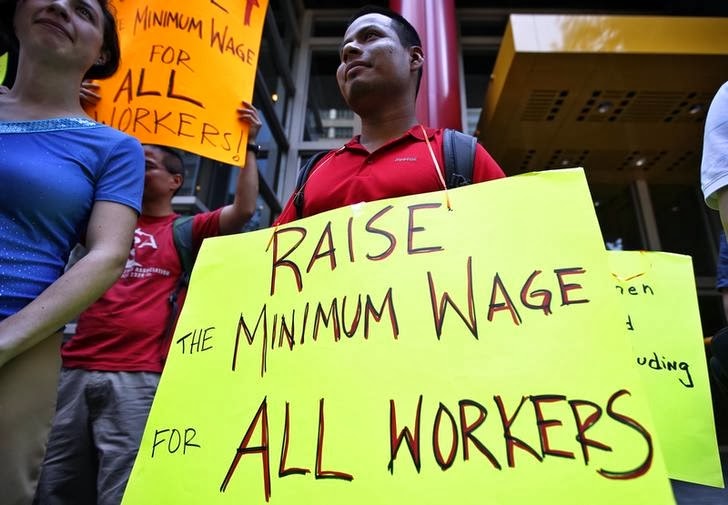
Everyone in the State of California is waiting on the upcoming incremental increase in their state minimum wage. The passage of Administrative Bill 10 last year provided for a yearly wage increase up to 2016, wherein the current per-hour rate of $8.00 will be raised to $9.00 come July this year. On 2016, the state would raise it yet again by another dollar, which would put California’s per-hour minimum wage rate at $10.00. It was the first wage hike by the state in five years and this would potentially provide around 2.4 million Californians extra earnings.

Most labor unions and organizations in the state heavily lobbied for the bill, which was authored by Assemblyman Luis Alejo (D-Salinas) (read more) and consequently won votes on both the Assembly and the Senate after it was finally signed by California Governor Edmund “Jerry” Brown. However, not all groups are in favor of the bill, especially business organizations within the state.

In fact, the California Chamber of Commerce considered the then-bill as one of the so-called “job killers.” It argued that imposing a $2.00-increase in the minimum wage over the three-year period would cause businesses, no matter how big or small they are, to incur costs despite “other economic factors or costs that California employers are struggling with to sustain their business.” While that didn’t stop the proponents of the bill to continue its passage and the imminent $9.00-increase for this year, there are still a lot of people and groups that continue to warn of its negative implications on the California economy.

The proponents of the wage increase argue that with the additional $2.00 over the next three years, poverty can be reduced and that it would help stabilize low-skilled labor due to employers being able to save on money, especially on training and recruitment. Meanwhile, those who are against it, including the state’s Chamber of Commerce, believe that this would not only cost businesses, but also promote further unemployment. Additionally, fast food restaurants and all other similar establishments see the wage increase as having a marginal impact on the prices of the goods they’re selling.

Nevertheless, the impact of the California wage increase in both employers and workers can only be felt as the law becomes effective July this year. Meanwhile, for a Los Angeles labor lawyer, employers must still focus on providing their wage earners their minimum wage, as well as overtime and meal and rest breaks, and deal with the upcoming changes later.

Sources: http://www.nerdwallet.com/blog/investing/2013/californias-minimum-wage-increase-expert-faq/

Posted on Friday, March 07, 2014 by Unknown

1 comment

05 March 2014

http://www.employmentattorneyservices.com/sexual-harassment.html
 
Sexual harassment in the workplace is still a lingering issue not only in California, but in the whole country. It is commonly associated with unwelcome advances that are sexual in nature, which are usually done verbally or physically. However, that is not always the case, as sexual harassment may also involve remarks that discriminate a certain person on the basis of his or her sex. For example, it is considered as such if a co-worker makes an offensive comment towards a female employee about women in general.

It’s easy to suspect that an individual in the workplace—manager, supervisor, or co-worker—is sexually harassing someone. One can quickly point that out if he or she is frequently being shown pictures that are sexual in nature, or constantly being touched or groped without his or her consent. However, there are applicants and employees who know they are being subjected to such, but are not sure of what to do, much less react.

If you are one of those individuals, then it would be best if you act on it as soon as possible. Here is a list of the things you need to do if you are being sexually harassed by someone at work:

•    Employees who were subjected to sexual harassment for the first time tend to quit their jobs right away. Doing so, however, decreases their chances of bringing up claims of sexual harassment. If your employer has a company policy on it, make sure that you report it to your HR or any department. Allow your employer to address the matter.

•    With regard to reporting an incident of sexual harassment, ensure that your company has a policy for it. Check with your employee handbook and your workplace posters for it; the policy has specific instructions on how to report the incident and to whom the complaint should be submitted. If the person designated to fix such employment issues is the one who has been harassing you, submit your complaint to the next designated one.

•    Make sure that your complaint should be written. It should detail every instances of sexual harassment, as well as the dates, locations, and the circumstances that led to these incidents. It must indicate that you are being discriminated or harassed either because of your sex or you’re being subjected to sexual advances.

•    If the designated person or department tasked to do something about your complaint doesn’t do anything and the harassment still continues, you can go seek an appropriate employment agency that can help you file a lawsuit against your employer. It could be with the Equal Employment Opportunity Commission (EEOC) or with the California Department of Fair Employment and Housing (DFEH). You may also hire an expert Los Angeles employment lawyers. Typically, case evaluations with these legal counsels are free of charge.

•    If the instances of sexual harassment are severe or frequent that it already promotes a hostile working environment, then it may be time to quit. Word of advice though: just make sure you do so if you think your health or welfare is at risk, or you already have obtained a new job.

Everyone is entitled to work in an environment that is free from any sexual advances, let alone acts of discrimination on the basis of one’s sex. As a California employee, you must know that you are protected by various employment and labor laws that prohibit sex discrimination and harassment. Exercising your rights, like doing the things enumerated above, will help you obtain the justice you deserve against the actions of the harasser.

Posted on Wednesday, March 05, 2014 by Unknown

No comments

25 February 2014

 
It is never a good thing to discriminate an employee on account of his or her age. To begin with, it is not allowed under prevailing employment laws such as the Age Discrimination in Employment Act (ADEA) and the California Fair Employment and Housing Act (FEHA) to deliberately harass and/or subject a senior employee age 40 years or older to any unfavorable employment action. Although it is not an uncommon occurrence for a lot of employers to subject older employees to layoffs or demotions, there have been a lot of instances wherein they become less favored, with younger, less qualified employees landing eloquent jobs or promotions.

Proving age discrimination
  • Any of situations stated above may be considered age discrimination, but the burden of proof always rests on the aggrieved senior employee. The task of proving the employer or co-worker’s discriminatory actions can be difficult, which is why it is imperative for him or her to seek the expertise of an expert Los Angeles discriminatory attorney. Meanwhile, here are some instances that can help prove age discrimination in the workplace:
  • In most age discrimination and harassment cases, there is always the situation wherein the older employee is subjected to harsh comments or remarks directed toward him or her about his or her age. Those are already direct evidence of age discrimination, and must be noted through writing. The names of those involved, as well as the places, times, and dates of the incidents, should be included.
  • It is age discrimination if the older employee is constantly being reprimanded or disciplined for violations that younger employees also commit without receiving any write-ups.
  • Leaving behind an older worker in various instances at work, from training, important company events, to even lunch breaks can be used as evidence for one’s age discrimination claim. Also, age discrimination is evident if the bosses suddenly favor younger employees over older ones, especially when it comes to job assignments, office space, and in promotions.

Important steps to take when getting discriminated because of age
  • When an older employee gets involved in any of the abovementioned instances by his or her employer or co-worker, then it is best that he or she should act immediately. Before hiring a Los Angeles employment lawyer who specializes in handling discrimination claims, here are some important steps to take right after a certain workplace incident:
  • Put into writing the details of every event that is deemed discriminatory. It is important to include when and where they happened, as well as who were involved. Keeping important documents is likewise imperative, especially if they can help shed light to the situations, such as disciplinary write-ups and demotion or termination letters.
  • All pieces of evidence must be kept away from the office, and must be instead kept at home. They can be retrieved once the aggrieved employee is ready to file an age discrimination or harassment lawsuit against his or her company.
  • Before doing that, though, it is important for him or her to first report the incident by writing a formal complaint with the human resource department or administrative office. It would be right to give them the chance to investigate what happened.
  • If nothing happened and the complaint was all for naught, then you must consult with the employment lawyer immediately. It is likewise imperative to file charges against your employer through the Equal Employment Opportunity Commission (EEOC) or the Calif. Department of Fair Employment and Housing (DFEH).

Posted on Tuesday, February 25, 2014 by Unknown

No comments

19 February 2014

http://www.employmentattorneyservices.com/sexual-harassment.html

 Employment harassment is prohibited under the California statute, the Fair Employment and Housing Act (FEHA). Every form of harassment is illegal, from sexual harassment, gender harassment, and all other forms of harassment based on the protected characteristics defined by the said law. Not only do covered employers have to avoid harassment at all times, but must also take all reasonable steps to prevent it.

When it comes to sexual harassment, covered employers are required to provide information to every employee “on the nature, illegality, and legal remedies that apply to” it. They can do so by posting publications of their own, which should be pursuant of the state’s Government Code section 12950. They may also obtain a brochure from the California Department of Fair Employment and Housing (DFEH) (read more).

More importantly, covered employers, especially those who employ 50 or more individuals and those in the public sector, are required to conduct training that would help prevent sexual harassment in workplaces. But why do so anyway? The answer is rather simple: it is good for the business.

Basically, sexual harassment prevention training is a requirement that would help them avoid issues that may greatly affect their business operations. This training is held every two years, and making this an important focus in California businesses would prevent them from challenging expensive lawsuits filed by their sexually-harassed employees. When there’s no single sexual harassment situation in a workplace, daily operations are not only smooth and productive; employees are more encouraged to perform their duties.

Basically, employers must make it a point to educate employees about what sexual harassment is and how to prevent it from happening in their respective workplaces. It should reflect in their existing policies, as well as in their daily correspondence with their workers. Coverage of training also includes responding to sexual harassment complaints and possible effects to the business if a situation happened that can be deemed as sexual harassment.

Meanwhile, if you are an employee for a California business entity, make sure that it has a written policy on sexual harassment, which should definitely include training. Otherwise, it is best that you report it with the DFEH. Also, if you have been harassed in any way, it is in your best interest to consult with a Los Angeles employment lawyer.

More information about Sexual Harassment Law at http://www.employmentattorneyservices.com/sexual-harassment.html

Posted on Wednesday, February 19, 2014 by Unknown

No comments

11 February 2014


“American Idol” has been sued a lot of times before, albeit the lawsuits it faced don’t considerably amount to around a million or so. However, entertainment website TMZ.com reported recently that the TV show is facing another lawsuit filed by 10 of its former contestants from various seasons, all of whom are African-Americans.

Apparently, they are claiming that they were eliminated from the singing competition due to a racist ratings scheme, in which, according to TMZ, they were “unjustly booted because of their race.” Aside from the plaintiffs seeking to force “Idol” to adopt new anti-racism regulations, all of the plaintiffs are each seeking $25 million in damages.

In the TMZ’s article dated July 24, the ten former “Idol” contestants “have accused producers of conducting a ‘cruel and inhuman’ scheme to exploit them for ratings by illegally digging up their arrest histories and using the records to humiliate them on national TV.” The legal representative of the plaintiffs, New York attorney James H. Freeman, claimed that it starts as early as the background checks wherein producers will ask “Idol” hopefuls if they had ever been arrested.

Per TMZ, the attorney even claimed that African-American contestants were the only ones to be probed about their alleged criminal past and not white people. Moreover, he emphasized that since his clients are applying for “employment” with the TV show, they are not allowed to ask about their arrest histories and other confidential details during background checks. He claimed that what “Idol” did was in violation of the California employment laws.

For many people, such lawsuits filed against the decade-long TV show are based on various individuals trying to make fast money. They also believe that the “American Idol” is hardly racist at all, since there have been African-American contestants who have been included in the competition in its 12 seasons. But then, whether or not this lawsuit against the show will go the distance remains to be seen.

Incidentally, expert lawyers, including an experienced Los Angeles discrimination attorney, assert that discrimination in employment on the basis of race is illegal under federal and California laws and statutes.

Posted on Tuesday, February 11, 2014 by Unknown

No comments

16 December 2013

Age Discrimination on Workplace in Los Angeles

 Workplace discrimination in the workplace, especially in Los Angeles and in the whole of California is usually on the basis of one’s race, sex, and disability. But then, not a lot of people are aware that there other instances wherein employers subject their employees and applicants to workplace bias on the basis of their ages. Cases of age discrimination in the workplace may not happen all too often, but such actions related to it are prohibited under the federal and California employment and labor laws.

What is age discrimination?

This form of workplace bias involves an action or conduct in which an employee or applicant becomes less favored in any aspect of employment because of his or her age. An employee or applicant is said to be discriminated against because of age in these following situations: 
  • The employer decides not to give an older but qualified candidate a job because of the latter’s age, and not because he or she did not meet the minimum qualifications of the job.
  • The supervisor, manager, or any authority in the workplace makes offensive comments towards senior employees frequently, up to the point the work environment becomes hostile. Remarks such as “old man” and “grandma,” as well as uttering biased statements that degrade senior employees, are signs of workplace discrimination.
  • A sign of age discrimination is when senior employees are frequently disciplined for doing something that other younger employees do but are able to get away with it.
  • An older, more qualified employee was denied a promotion for a vacant job opening in the workplace. Instead, the employer handpicked a younger, inexperience employee to take that job vacancy.
  • It is also age discrimination if the employer decides to mass layoff employees, particularly the older ones, in an effort to instill a younger image within the company.

Laws that prohibit age discrimination in Los Angeles, California

Age discrimination in Los Angeles, California is prohibited under some notable federal and state employment and labor laws. One of them is the federal Age Discrimination in Employment Act (ADEA), which prohibits age discrimination against employees who are over 40 years of age in all aspects of employment, from hiring to termination. Also, it is not illegal under ADEA for an employer or any covered entity to favor an older employee over a younger one, even if both of them are 40 years or older. This federal Act is enforced by the U.S. Equal Employment Opportunity Commission (EEOC).

Another law is the State of California’s Fair Employment and Housing Act (FEHA). This state employment law, like the ADEA, protects workers aged 40 or older from age discrimination. Not only does the FEHA provide employment protections from age-related bias in the workplace, but also from other protective characteristics, to include race, religion, gender, disability, and sexual orientation. The FEHA is enforced by the California Department of Fair Employment and Housing (DFEH).

Exercising your legal rights
If you have been discriminated in the workplace because of age, or was harassed or subjected to retaliation under the same circumstances, then you must know that you are entitled to exercise your legal rights against your erring employer. Pursuing an age discrimination case against your Los Angeles, California employer should be your top priority. In order to do so, however, you must first seek the legal services of topnotch and respected age discrimination lawyers in Los Angeles. That way, you will have an enhanced chance of not only obtaining compensation from the erring party, but also obtain the justice you truly deserve.

Posted on Monday, December 16, 2013 by Unknown

1 comment

12 August 2013


Image Source:  http://www.sterlingeducation.com/Portals/90102/images/MP900407410.JPG

An employer-employee relationship comes with so many responsibilities, especially on the part of the former. For the most part, it is the companies that must identify such relationship so that employment matters such as compensation and work hours can be established. However, some of them try to swerve away from what is stated under the law by misclassifying their hires as either exempt, instead of non-exempt, or independent contractors, instead of merely employees.

Basically, misclassifying employees is against the provisions of the Fair Labor Standards Act (FLSA). Sadly, this employment scheme has been on the rise as of late, as evidenced by the recent announcement from the U.S. Department of Labor (DOL) in 2012 in which two big-time companies, FedEx and Wal-Mart, had been sued over employment misclassification.

Wal-mart has since agreed to pay over $5 million in back wages and damages to more than 4,500 employees after a DOL investigation found that the employer misclassified them in order to not provide them overtime wages. Meanwhile, lawsuits against FedEx have had mixed results.

Cases of employee misclassification, particularly on identifying employees as independent contractors, are on the rise today, resulting to lawsuits. Acting deputy administrator Mary Beth Maxwell of the DOL Wage and Hour Division (WHD) said in a press release that such instances deny employees “access to critical benefits and protections to which they are entitled, such as minimum wage and overtime, family and medical leave, and unemployment insurance.”

Some employers often misclassify employees as independent contractors in an effort to save thousands of dollars in workmen’s compensation and unemployment insurance. Worse, it costs states millions in unpaid taxes.

Fortunately, there have been cases wherein misclassified employees working as cable installers, security guards, and even local government workers who came out victorious after filing charges against their employers. Thanks to the DOL’s Misclassification Initiative, California and 12 other states have been on a joint effort to go against employers that engage in misclassifying employees.

Meanwhile, if you work in California and you have been misclassified by your employer as an independent contractor instead of a non-exempt employee (or an exempt employee rather than a non-exempt one), it is important that you exercise your rights. You may file a complaint with the California Department of Labor Standards Enforcement (DLSE), or alternately consult with a Los Angeles labor lawyer for your legal options.

Posted on Monday, August 12, 2013 by Unknown

1 comment

18 June 2013

Social Media on workplace | employment law

Image Source: http://labor.mo.gov/img/socialMediaWP.PNG
 Facebook, Twitter, Pinterest, Tumblr, and other social networking sites have been the main past time of so many people. Through these avenues, people have been expressing their thoughts. People post their daily activities, interesting finds on the net, photos, and random rants.

Social media as an effective tool for employers
In a lot of instances employers view their workers’ social media accounts as tools of better communicating with them. Such tools would also help employers find out how their employees feel, including their rants about certain personalities at work and working for a certain company in general. In fact, a lot of employees have been sacked because of their ‘incriminating” posts online. Well, this may change soon.

Online accounts protection bill signed
Recently, California Governor Jerry Brown has signed two landmark laws: Senate Bill 1349 and Assembly Bill 1844. These are laws that bar employers from “demanding” the social media accounts and their login credentials. These newly-signed laws are set to protect employees from the use of their private social media accounts and their posts to remove them from their jobs.

What does this mean to you
Now you have the freedom to express your feelings on your social media accounts without the fear of being removed or being subjected to politics in the office. This gives an employee peace of mind when using their social networking accounts and lessens the worries one thinks about when using his social networking account.

Problems with the new laws
These may seem to be good laws since it is just plain ridiculous to force people to divulge their social media content to their employers. However the same are nothing but blunt tools that does not solve all of the problems about employees’ privacy. However, there are certain parties that claim to have seen flaws with these laws. First, the definition of “personal accounts” in these laws is said to be a bit flawed. This confusion may leave an employer what exactly is an employee’s personal account.

If your employer has been forcing you to give your log in credentials, invoke your right under these new laws. Ask a Los Angeles employment lawyer on how you can defend yourself and your privacy under this new law. A Los Angeles attorney can better interpret this new law so to be sure that you can better defend yourself and fight for your rights under this new legislation.

Posted on Tuesday, June 18, 2013 by Unknown

1 comment

07 June 2013


Image Source: http://california-employmentattorneys.com/wp-content/uploads/2012/11/fired.jpeg

Every day at work is a great challenge for anybody. It is the responsibility of the employer to make sure that their employees are working in an environment that is conducive for working: A workplace that encourages them to work harder and aim for success. The United States, has all of the laws needed to make sure that employees are protected from any form of harassment, abuse, and discrimination. However, there are still a few instances of such in these modern times.

Employees of a petroleum and gas industry equipment provider recently have scored a victory against their employers. These workers have been subjected to racial harassment. After they have filed a complaint in the management of the company, they were treated bad and retaliated by their bosses. They assigned the workers to do menial tasks, not the ones included in their job description. The company reduced their wages and eventually terminated from them from their jobs.

Fighting for what is right
The workers, have approached the US Equal Employment Opportunity Commission (EEOC) and filed a complaint. After an intense legal battle, the employees won their complaint and are set to receive more than $150,000 in lost wages and damages. Race discrimination and retaliation is a clear violation of the Title VII of the Civil Rights Act of 1964. If you have been a victim of workplace discrimination based on one’s sex, religion, color, age, and/or race, one should immediately seek legal remedies by filing the right complaint in the proper agencies.


Los Angeles wrongful termination lawyers reminded people that coming forward and fighting for their rights is the only way that harassment, abuse, discrimination, and retaliation could be stopped. These lawyers recommended the hiring of Los Angeles attorneys as they know the many labor and employment laws and regulations in the state. These lawyers will be the best people to approach regarding legal matters in California. In the end, the fight against race and other forms of discrimination, harassment, abuse, and retaliation can only be won if the workers are aware of their rights and come forward to fight the oppression that they are experiencing.

Posted on Friday, June 07, 2013 by Unknown

No comments

31 May 2013


Image Source: http://blogs.mydevstaging.com/blogs/to-the-max/files/2011/10/handicapped-spot-photo.jpg

Disabled people may have limitations, but that does not make them less of a person. These people may not be able to do certain things, but just like any “normal” person, differently-abled people have special skills that can contribute to a family, a community, or a workplace. The Department of Labor realizes the value of these people that is why this early, the agency has already came up with an annual theme for the National Disability Employment Awareness Month this coming October 2013.

Conception of a Disability Employment Awareness annual celebration
The Congress, back in 1945 has assigned a week in October every year to commemorate a “National Employ the Physically Handicapped Week”. The commemoration of this annual event is a perfect celebration of the DOL’s continuing efforts to promote equality among “normal” and disabled people in the workplace.

This year’s theme for the celebrations

“Because We Are EQUAL to the Task”, this year’s theme has been chosen by the U.S. DOL’s Office of Disability Employment Policy. According to the agency, this theme perfectly echoes the importance of giving education, training, experience to persons with disabilities that help them develop the desire for them to be successful in life despite their limitations.

Benefits of this yearly program
In line with this year’s Disability Employment Awareness month campaign, the ODEP continues their aim to promote positive employment outcome for people with disability. The agency also aims to highlight the idea of that the youth with disabilities are capable of doing, given the encouragement and support for them to reach their dreams. This program goes with the agency’s efforts together with various business and disability organizations, emphasizing the focus on what an individual can do more than their disabilities.

According to a Los Angeles employment lawyer, despite the many efforts of the government and cause-oriented groups, differently-abled people are still suffering from the discrimination and judgment of other individuals because of their disabilities. This Los Angeles attorney believes that programs such as these do not only help promote the rights of disabled people in the workplace, it also helps people understand how one can better treat a disabled person. Moreover, this can perfectly give the much-needed encouragement that people with disabilities need to carry on and continue sharing their talents and skills in the workplace to help move the economy forward.

Posted on Friday, May 31, 2013 by Unknown

No comments

22 May 2013

age discrimination, employment discrimination
 Image Source: http://b-i.forbesimg.com/nextavenue/files/2013/04/what_it_takes_to_win_an_age_discrimination_dv2173013_0.jpg


People say that wines only get better in time. As wines are aged, their taste and value rises. That could very well be the same for people. However, not everybody sees it that way. Employers somehow think that older workers are slow in adapting to the many changes that the modern times offer. They think that the elders lack the speed and the efficiency that younger employees have. Plus older employees have higher wages, more benefits, and are more likely to miss work because of the many ailments that they might contract along the way.

Because of these things, some employers tend to discriminate against older employees. These acts of age discrimination are punishable by law as stipulated in Title VII of the Civil Rights Act and the Age Discrimination in Employment Act (ADEA). If you have been a victim of such discrimination, you should immediately report it to the authorities. But how can you report such offenses? Here are some tips.

  • Get solid proof. Gather your performance reviews and other records that can prove your performance with your ob. This would help solidify your claim that you are really being discriminated against and that it has something to do with your age.
  • Document the acts. Jot down the date, time, as well as other information about the incidences of discrimination were made against you. Determine what kind of discriminative act did your co-employee, supervisor, or company has made against you. This could help bolster your case’s chances of prospering.
  • Provide your and the company’s contact info. Also, provide a short description of what happened and how you related are they to age discrimination.
  • Report the incident to the Equal Employment Opportunity Commission (EEOC). File the complaint as soon as possible so you won’t have problems with the statues of anti-discrimination laws.
  • Wait. The most difficult thing to do, you should wait patiently until your complaint is resolved. You can also follow up on your complaint every now and then. This will keep you updated about what’s going on with your case as it is being processed.

Age discrimination cases, like any case filed in the courts, may take time before it is resolved. That is why your patience will be very critical during these very difficult times. In the end, when you know that you have done everything that you need to stand up against discrimination and fight for your rights, all the pain, hardships and sufferings that you have to endure.

Posted on Wednesday, May 22, 2013 by Unknown

No comments

20 May 2013

Image Source: http://legalplanet.files.wordpress.com/2011/10/calchamberlogo.jpg
Proposed bills in California that concern the state’s employment and labor undergo extensive hearings and deliberations before they go through a vote among legislators. Once a bill is voted in favor of the majority of a certain committee, it is then passed on to undergo the same process again, until the proposal is sent to the Governor to either sign or veto it.

The pending employment and labor bills this year are aggressively being heard and deliberated among legislators in the state’s Assembly floor and the state’s Senate. While a lot of them support the bills, some others, including business and industrial organizations, think otherwise.

In fact, the California Chamber of Commerce last month released a list of pending bills that would create a negative impact on the job climate and economic recovery of the state once these bills are signed to law by the Governor. These are the so-called “job killers.”

Here is some of the “job killers” mentioned in the list released by the California Chamber of Commerce:

  • Assembly Bill 5 and Senate Bill 404. These proposed bills will add homelessness and “familial status” in the protected characteristics under the California Fair Employment and Housing Act (FEHA). According to the Chamber, these proposals, if passed, would make it impossible for employers to manage their employees and that they would be exposed to being litigating due to the expansion of the FEHA.
  • AB 10. This bill would increase the California minimum wage from $8.00 to $9.25 by 2016, indexing the minimum wage based on inflation. It is included in the list because it failed to take into account the current economic status of the state, among other concerns. This bill is currently being heard at the Assembly floor after it passed the Assembly Labor and Employment Committee.
  • SB 761. This proposed bill would provide family leave as paid protected leave. It is included in the “job killers” list because it is said to create a new burden for small businesses and the possibility of further litigations because of the transformation of the paid family leave program.

Meanwhile, a Los Angeles employment lawyer believes that while these and all other bills are considered “job killers,” there is still room for talks as to these bills, if passed into law, could benefit business groups, as well as employers and employees.

Posted on Monday, May 20, 2013 by Unknown

No comments